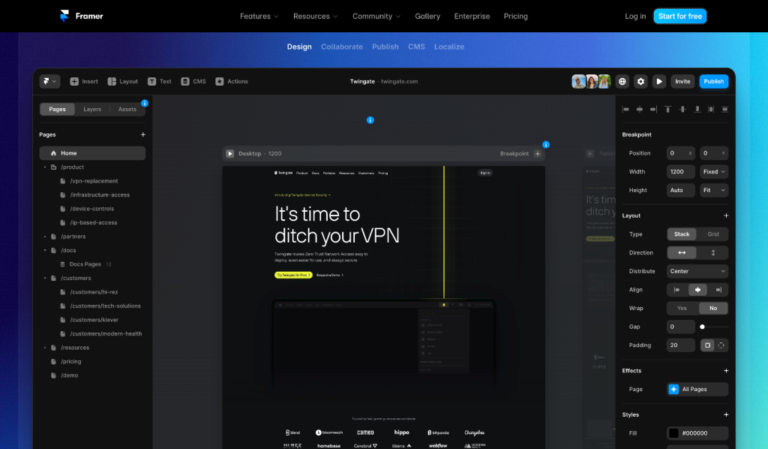
Framer is a visual website-building platform that allows users to design and publish websites without relying heavily on traditional coding. Its interface is heavily inspired by modern design tools, making it particularly attractive to UI/UX designers.
Unlike traditional page builders, Framer focuses strongly on visual design, responsive layouts, interactions, and animations. You can create landing pages, portfolios, startup websites, marketing websites, and other modern web experiences directly within the platform.
1. Visual Website Design
Framer provides a visual canvas where you can design pages and arrange elements with considerable control. Designers can work with layouts, spacing, typography, components, and responsive behavior without constantly switching between design and development tools.
2. Responsive Design
Responsive websites are essential today, and Framer provides tools for adapting designs to different screen sizes.
You can customize layouts for desktop, tablet, and mobile devices, helping ensure that your website looks good across different screens.
3. Animations and Interactions
One of Framer’s biggest strengths is its ability to create attractive animations and interactions.
You can add effects such as:
- Hover animations
- Scroll effects
- Page transitions
- Element animations
- Interactive buttons
- Smooth visual transitions
This makes Framer particularly useful for websites where visual presentation is important.
4. Components
Framer supports reusable components, which can make maintaining a website much easier.
For example, you can create a button or navigation component once and reuse it throughout the website. Changes to the main component can then be reflected across its instances.
5. CMS
Framer includes CMS functionality for managing structured content. This can be useful for blogs, case studies, projects, team members, and other types of repeatable content.
For businesses that regularly publish content, having CMS functionality built into the website builder can reduce the need for additional tools.